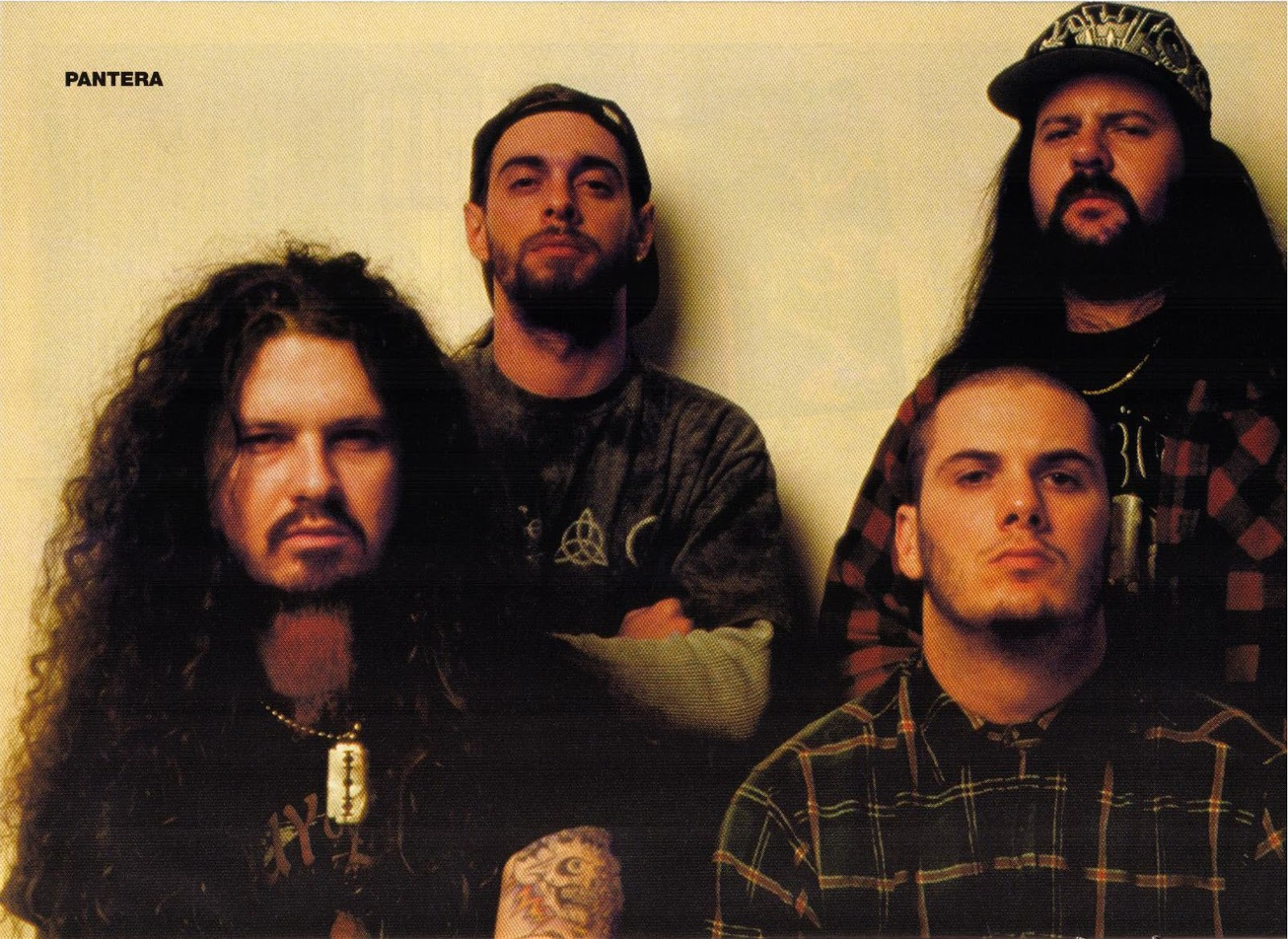
Pantera

Posted by G.C | Posted on 8:23 AM

1


Pantera was an American heavy metal band from Arlington, Texas. They were formed in 1981 by the Abbott brothers, Vinnie Paul (drums) and Dimebag Darrell (guitar), along with vocalist Terry Glaze. Bassist Rex Brown joined the band the next year. Looking for a new and heavier sound, Pantera had Terry replaced in 1987 with Phil Anselmo as the new vocalist. Pantera has sold around 20 million albums. Starting as a glam metal band, Pantera released four albums during the 1980s. For their fifth album, Cowboys from Hell, released in 1990, Pantera introduced a heavier groove and thrash metal sound. Their sixth album Vulgar Display of Power, released in 1992, revealed a heavier sound than Cowboys from Hell and their 1994 release of Far Beyond Driven debuted at No.1 on the Billboard 200.
Tensions began to surface amongst the band members when Phil Anselmo became addicted to heroin in 1995. This resulted in the recording sessions for The Great Southern Trendkill to be held separately. The ongoing tension lasted for another seven years, in which only one studio album, Reinventing the Steel was released in 2000. The band went on hiatus in 2001, but the Abbott brothers disbanded Pantera in 2003 after concluding Anselmo would not return to the band. The Abbott brothers went on and subsequently formed Damageplan, while Anselmo and Brown focused on their side project with Down. Any hopes of a reunion were lost on December 8, 2004, when Dimebag Darrell was shot and killed onstage by a mentally unstable fan during a Damageplan concert in Columbus, Ohio.


History


Formation and early glam years (1981–1987)

The band was originally named Pantera's Metal Magic and consisted of Vinnie Paul Abbott on drums, Dimebag Darrell Abbott (called Diamond Darrell at that time) on guitar, Donnie Hart on vocals, Terry Glaze on guitar, and Tommy Bradford on bass. In 1982, the band was renamed Pantera in order to shorten the name and to settle an agreement between all band members. Hart left the band because he did not agree with the band's ethics and Glaze became the group's vocalist, leaving Darrell as the solo guitarist. Later that year Bradford also departed and was replaced by Rex Brown (then known as Rexx Rocker). Pantera became an underground favorite, though its regional tours in this era never took them beyond Texas, Oklahoma, and Louisiana. The band began supporting fellow heavy metal acts such as Stryper, Dokken, and Quiet Riot, who in turn promoted Pantera's debut, Metal Magic. Metal Magic was released on the band's record label of the same name in 1983 and produced by the Abbott brothers' father, Jerry Abbott (referred to as "The Eldn"), at Pantego Studios.
The following year, Pantera released its second album, Projects in the Jungle. Though still very much a glam metal album, the band members crafted songs that had less overbearing melodic influences than songs from Metal Magic. Another change was Terry Glaze's name, as he was henceforth credited as "Terrence Lee". In addition, a music video for the album's lead track, "All Over Tonight", was eventually created. Projects in the Jungle was also released on the band's independent Metal Magic Records label and produced by Jerry Abbott.
In 1985, Pantera again released a full-length album on Metal Magic Records, entitled I Am the Night. As with Projects in the Jungle, this album saw Pantera's sound becoming heavier (though still rooted in glam metal), and the heavy metal press took more notice of the band. Because of poor distribution, I Am the Night was a costly album to many fans. Around 25,000 copies of I Am the Night were sold. Pantera's second music video was produced for the track "Hot and Heavy".


Anselmo's induction (1987–1989)

1986 and 1987 saw the release of several landmark thrash metal albums that would prove influential to Pantera's developing musical style. Among the most prominent of these were Metallica's Master of Puppets, Slayer's Reign in Blood, Anthrax's Among the Living and Megadeth's Peace Sells... but Who's Buying? Terrence Lee's glam approach did not fit the band's new outlook and he and the other members parted ways, beginning the search for his replacement. Terrence then went on to form rock group, Lord Tracy.
The band went through temporary vocalists Rick Mythiasin, Dave Peacock and Matt L’Amour before eventually discovering New Orleans native Phil Anselmo in 1987. Anselmo had previously been the vocalist for the bands Samhain (not to be confused with Glenn Danzig's band of the same name) and Razorwhite. Upon playing with Pantera, Anselmo immediately clicked with the other three members. More than just the band's image was changing, however. In 1988, Pantera released its first album with Anselmo, entitled Power Metal. By far the band's heaviest album at this point, Power Metal was a mix of 1980s hard rock and thrash metal, sometimes blending both styles in a single song. Complementing the band's new sonic approach was Anselmo's harder-edged vocals compared to those of Terrence Lee. After the release of Power Metal, the band members decided to seriously reconsider their glam metal sound and image. Referring to the band's spandex appearance, Vinnie Paul remarked at a band meeting that "These magic clothes don't play music; we do. Let's just go out there and be comfortable—jeans, t-shirt, whatever—and see where it goes."
As with the previous three 1980s albums, Power Metal was released on Metal Magic Records. Power Metal showed a change in their sound. The band members would later ignore their independent releases, including Power Metal, as they sculpted a new, heavier image to accompany their later groove metal sound. Their four independent albums are not listed on the band's official website and have become hard-to-find collector's items.


Cowboys from Hell (1989–1991)

Shortly after Power Metal was released, "Diamond Darrell", as he was then known, auditioned for Megadeth's vacant guitarist slot, and was invited to join the band. Darrell insisted his brother, bandmate Vinnie Paul, be included, but because Megadeth frontman Dave Mustaine had already hired a drummer, Nick Menza, Darrell declined and Mustaine instead decided on Marty Friedman. The Abbott brothers refocused their attention on Pantera, and in 1989 they were given their first shot at commercial success. 1989 was also when the band formed their relationship with Walter O'Brien at Concrete Management (the management arm of Concrete Marketing), who remained their manager until they disbanded in 2003.
After being turned down "28 times by every major label on the face of the Earth", Atco Records representatives Mark Ross and Stevenson Eugenio were asked by their boss Derek Shulman, who was interested in signing Pantera, to see the band perform after Hurricane Hugo stranded them in Texas. Ross was so impressed by the band's performance that he called his boss that night, suggesting that Pantera be signed to the label. Atco Records accepted, and at the close of 1989, the band recorded its major label debut at Pantego Studios.
Released on July 24, 1990, and produced by Terry Date and Pantera, Cowboys from Hell was another leap into heavier territory. Pantera showed a more extreme style on this outing, leaving behind its glam metal influences in favor of an amalgamation of thrash metal and groove metal dubbed "power groove" by the band. Although Anselmo still used Eric Adams-influenced falsetto vocals, he also adopted a more abrasive delivery. Darrell's more complex guitar solos and riffs, along with his brother's faster-paced drumwork were evidence of the band's extreme transformation. The album marked a critical juncture in the band's history. Many fans, as well as the band itself, consider it Pantera's "official" debut. Cowboys included the tracks "Cemetery Gates", a brooding seven-minute piece that focuses on death and religion, and the thrashing title track, which gave the band members their nickname and asserted their raucous personality and style.
So began the Cowboys from Hell tour alongside thrash acts Exodus and Suicidal Tendencies. In 1991, Rob Halford performed with the band onstage, which led Pantera to open for Judas Priest on its first show in Europe. The band eventually landed a billing for "Monsters in Moscow" with AC/DC and Metallica in September 1991, where they played to a crowd of over 500,000 in celebration of the new freedom of performing Western music in the Soviet Union shortly before its collapse three months later. The band was often found at the Dallas club "the Basement", where the band shot the videos for "Cowboys from Hell" and "Psycho Holiday". Pantera's 2006 home video compilation 3 Vulgar Videos from Hell features performances of "Primal Concrete Sledge", "Cowboys from Hell", "Domination", and "Psycho Holiday" from the show in Moscow.


Vulgar Display of Power and Far Beyond Driven (1992–1994)

Pantera's unique "groove" style came to fruition in its breakthrough album Vulgar Display of Power, released on February 25, 1992. On this album, the power metal falsetto vocals were replaced with a hardcore-influenced shouted delivery and heavier guitar sound. Two other singles from the album became two of Pantera's most notable ballads: "This Love", a haunting piece about lust and abuse, and "Hollow", somewhat reminiscent of "Cemetery Gates" from Cowboys. The band would play the song "Domination" (from Cowboys) leading into the ending of "Hollow" (what is roughly the last 2:30 of the album version), forming a medley referred to as "Dom/Hollow", as can be heard on the band's 1997 live album. Singles from Vulgar also received significant airplay on radio as did the companion music videos on MTV. The album entered the American charts at No. 44. Pantera hit the road again, visiting Japan for the first time in July 1992 and later performing at the "Monsters of Rock" festival co-headlined by Iron Maiden and Black Sabbath in Italy. It was around this time that Darrell Abbott dropped the nickname "Diamond Darrell" and assumed "Dimebag Darrell", and Rex Brown dropped the pseudonym "Rexx Rocker".
Far Beyond Driven (released on March 22, 1994) debuted at No. 1 in both United States and Australian album charts. The album's first single, "I'm Broken", earned the band's first Grammy nomination for "Best Metal Performance" in 1995. Driven saw Pantera continue its groove metal approach, while taking an even more extreme direction with its musical style. The album's original artwork (a drill bit impaling an anus) was banned, so it was re-released with the now familiar skull impaled with a drill bit. A limited edition was released with a slip-cover case. Also, a boxed set called Driven Downunder Tour '94 Souvenir Collection was released in Australia and New Zealand to coincide with the tours there. It featured Far Beyond Driven (with its original banned artwork) with a bonus 13th track, "The Badge" (a Poison Idea cover), the 5-track aLIVE and hostile e.p., and the Japanese collector's edition Walk EP, all presented in a special cardboard box with an 8-page color biography. Just like the other rare editions of Far Beyond Driven, this box set is very rare and is highly sought after.
Pantera hit the road again and toured South America, along with being accepted into another "Monsters of Rock" billing. At that festival on June 4, 1994, the Abbott brothers got into a scuffle with journalists from the music magazine Kerrang! over unflattering cartoon depictions of drummer Vinnie Paul. Then in late June, Anselmo was charged with assault for hitting a security guard after he prevented fans from getting on stage, Anselmo was released on $5,000 bail the next day. The trial was delayed three times. In May 1995, he apologized in court and pleaded guilty to attempted assault and was sentenced to 100 hours of community service. Pantera continued their tour of the United Kingdom in 1994 and eventually ended it in the United States where the band was opened for by fellow groove metal band Prong.


Band tension and The Great Southern Trendkill (1994–1996)

According to the Abbott brothers, frontman Phil Anselmo began behaving strangely and distanced himself from the band when they returned to the road in 1995. The rest of the band members first thought that Pantera's perception of his fame had gotten to Anselmo, but Anselmo cited back pain from years of intense performances as the reason for his erratic behavior. Anselmo attempted to subdue his pain through alcohol, but this, as he admits, was affecting his performances and "putting some worry into the band." Doctors predicted that with surgery, Anselmo's back problem could be corrected, but that the recovery time could be a year or more. Not wanting to spend that much time away from the band, Anselmo refused, and began using heroin as a painkiller.
Anselmo's on-stage remarks became notorious during this time. After stating at a Montreal concert that "rap music advocates the killing of white people", Anselmo denied accusations of racism, and later issued an apology, stating that he was drunk and that his remarks were a mistake.
In 1995, Down, one of Anselmo's many side projects, took off. Down was a supergroup consisting of Anselmo, three members of Crowbar—guitarist Kirk Windstein, bassist Todd Strange and drummer Jimmy Bower (also of Eyehategod)—and Corrosion of Conformity guitarist Pepper Keenan. Down's 1995 debut, NOLA, was a success, but shortly after the group members returned to their respective bands, leaving Down inactive for several years.
Pantera's next album, The Great Southern Trendkill (released May 22, 1996). It is often considered Pantera's "overlooked" album. Phil Anselmo recorded the vocals for this release in Nine Inch Nails frontman Trent Reznor's studio in New Orleans while the rest of the band members recorded in Dallas, evidence of the continued distancing between Anselmo and the rest of the band. In comparison to the band's previous efforts, there was a heavier emphasis on vocal overdubbing in a somewhat "demonic" fashion. Drug abuse is a recurring theme in Trendkill, as exemplified by tracks such as "Suicide Note Pt. I", "Suicide Note Pt. II" and "Living Through Me (Hell's Wrath)". "Drag the Waters" became the album's only music video, and likewise, the only track from the album to appear on the band's compilation album. Another Trendkill single, "Floods", achieved acclaim largely because of Darrell's complex guitar solo in the song, which ranked No. 15 on Guitar World magazine's list of the "100 Greatest Guitar Solos" of all-time.


Overdose, Official Live: 101 Proof, and side projects (1996–2000)

On July 13, 1996, Anselmo overdosed on heroin an hour after a Texas homecoming gig. After his heart stopped beating for almost five minutes, paramedics gave Anselmo a shot of adrenaline and sent him to the hospital. After waking up in the hospital, the nurse working in his room said "Welcome back to life, oh and you have overdosed on heroin." Anselmo apologized to his bandmates the next night, and said he would quit using drugs. The revelation of heroin use came as a shock to Vinnie and Darrell who were embarrassed by Anselmo's actions, according to Rita Haney, the guitarist's girlfriend. Anselmo said he had already overdosed twice before and guilt overcame him.
Some of the band's live performances were eventually compiled in its July 29, 1997 release, Official Live: 101 Proof, which included fourteen live tracks and two new studio recordings: "Where You Come From" and "I Can't Hide". Two weeks before the live album's release, Pantera received its first platinum album, for Cowboys from Hell. Just four months later, both Vulgar Display of Power and Far Beyond Driven went platinum as well. The band also received their second and third "Best Metal Performance" Grammy Nominations for Trendkill's "Suicide Note (Pt. I)" and Cowboys's "Cemetery Gates" in 1997 and 1998, respectively. The release of their video 3 Watch It Go earned them a 1997 Metal Edge Readers' Choice Award, when it was voted Best Video Cassette.
Also in 1997, Pantera played on the mainstage of Ozzfest alongside Ozzy Osbourne, Black Sabbath, Marilyn Manson, Type O Negative, Fear Factory, Machine Head, and Powerman 5000. Additionally, the band played on the 1998 UK Ozzfest tour alongside Black Sabbath, Ozzy Osbourne, Foo Fighters, Slayer, Soulfly, Fear Factory, and Therapy?, as well as touring with Clutch and Neurosis.
Around this time, Anselmo ventured into more side projects, such as playing guitars on Necrophagia's 1999 release Holocausto de la Morte, where he went as the alias "Anton Crowley", which combines the names of Church of Satan founder Anton LaVey and occultist Aleister Crowley. He also temporarily joined the black metal supergroup Eibon and contributed to that band's 2000 release. Another one of Anselmo's "Anton Crowley" projects was black metal band Viking Crown. The Abbott brothers and Rex Brown began their own country metal crossover project, Rebel Meets Rebel with David Allan Coe, around the same time.
Fans of the NHL's Dallas Stars were treated to a raucous fight song penned by Pantera and dedicated to their favorite hockey team during the Stars 1999 Stanley Cup Championship run. Throughout the season members of the team befriended members of Pantera. During a Stanley Cup party hosted by drummer Vinnie Paul, the Stanley Cup was damaged when Guy Carbonneau attempted to throw the Cup from the roof of Vinnie Paul's house into his pool. The Cup landed short on the concrete deck and had to be repaired by NHL commissioned silversmiths.


Reinventing the Steel and break-up (2000–2003)

Pantera returned to the recording studio with Anselmo in 1999 and cut its last album, Reinventing the Steel, which was released on March 21, 2000. Steel debuted at No. 4 on the Billboard 200 and included "Revolution Is My Name" and "Goddamn Electric", the latter of which featured a Kerry King outro solo recorded backstage in one take during Ozzfest in Dallas. "Revolution Is My Name" became the band's fourth nomination for Best Metal Performance in the 2001 Grammys.
In 2000, Pantera played on the mainstage of Ozzfest alongside Ozzy Osbourne, Godsmack, Static-X, Methods of Mayhem, Incubus, P.O.D., Black Label Society, Queens of the Stone Age, and Apartment 26. In November the band cancelled their planned tour after Anselmo broke his ribs after falling during his eighth annual House of Shock event.
The band once again returned to touring and visited the United States (where they were guest musicians on the show SpongeBob SquarePants in the episode "Pre-Hibernation Week"), Canada, South Korea, Australia, and Europe. The tour in Europe was cut short, however, by the September 11, 2001 attacks which left the band stranded in Dublin, Ireland for 6 days as a result of all flights being cancelled. Pantera played their last show in Yokohama, Japan at the 'Beast Feast' festival on 28 August 2001. This would be the last time the members of Pantera performed together. Back home, the band planned to release its fourth home video in Summer 2002 and record another studio album later that year, but neither came about.
Anselmo again engaged in numerous side projects. In March 2002, Down released its second studio album, Down II: A Bustle in Your Hedgerow, which featured Rex Brown on bass following Todd Strange's departure in 1999. Brown remained Down's full-time bassist until 2011, having appeared on their subsequent release in 2007. Also, in May of that year Anselmo's Superjoint Ritual released its debut, Use Once and Destroy. Vinnie Paul claims that Anselmo told him he would take a year off following the events of September 11, 2001 attacks, but Anselmo's touring and record output for both Superjoint Ritual and Down contradicted this. The Abbott brothers were frustrated, and held out for a time, assuming Anselmo would return. However, according to Anselmo, taking a break from Pantera was a "mutual thing" between each of the band members.
The Abbott brothers officially broke up Pantera in 2003, also the year when their "Best Of" compilation album was released (on September 23), when the Abbott brothers concluded that Anselmo had abandoned Pantera and would not return. The break-up of the band was not amicable and subsequently a war of words was waged between the former bandmates via the heavy metal and musical press. The Abbott brothers and Pantera crew members claimed that they tried numerous times to contact Anselmo over the phone to reorganize Pantera, but Anselmo maintains that they never called him. Caught up in the torrent was Rex Brown, who later said "It was a bunch of he said, she said nonsense that was going on, and I wasn't going to get in the middle of it." Anselmo's comment in a 2004 issue of Metal Hammer magazine saying that "Dimebag deserves to be beaten severely" typified Pantera's internal conflicts; Anselmo insists that this comment was tongue-in-cheek, and he was angered his comment ended up on the cover of the "god damn" magazine. This explanation was soon dismissed by Vinnie Paul, who said shortly after the 2004 murder of his brother that he had personally listened to the audio files of the interview and that Anselmo had not been misquoted or misrepresented, but said the exact words which appeared in the article.
In July 2004, Vulgar Display of Power went double-platinum, and The Great Southern Trendkill went platinum the next month.


Damageplan and the murder of Dimebag Darrell (2004)

After Pantera's breakup, Darrell and Vinnie formed a new band, Damageplan, with vocalist Pat Lachman and bassist Bob Zilla. The group released their first album, New Found Power, in February of 2004. The album was a commercial success; over 44,000 copies were sold in its first week alone and within a year over 100,000 copies were sold. However, some fans felt that Damageplan's material did not measure up to that of Pantera.
Tragedy struck on December 8, 2004. Damageplan was performing in support of their album at a show at the Alrosa Villa in Columbus, Ohio when, less than a minute into the first song of their set, mentally unstable Nathan Gale, 25, went onstage and shot and killed Darrell. Gale also killed fan Nathan Bray, 23, club employee Erin Halk, 29, and Pantera security official Jeff "Mayhem" Thompson, 40, and injured longtime Pantera and Damageplan drum technician John "Kat" Brooks and Damageplan tour manager Chris Paluska before being shot dead by Columbus police officer James Niggemayer.


Aftermath (2004–present)

When Anselmo called in the aftermath of the murders, Rita Haney, Darrell's girlfriend, answered one of Anselmo's calls and said she would "blow Anselmo's head off" if he attended Darrell's funeral. He was buried with Eddie Van Halen's black and yellow-striped Charvel electric guitar (sometimes referred to as "Bumblebee"), which was pictured with Van Halen on the inner sleeve and back cover of the album Van Halen II. Dimebag had asked for one of these guitars in 2004, shortly before he was shot. Eddie Van Halen originally agreed to make Darrell a copy of the guitar, but upon hearing of Abbott's death, offered to place the actual guitar in his casket. Dimebag was buried in a KISS Kasket. Inspired by the rock 'n' roll group KISS, he requested in his will that he be buried in one of the famous coffins. Kiss co-founder Gene Simmons said, "There were a limited number made and I sent mine to the family of 'Dimebag' Darrell. He requested in his will to be buried in a Kiss Kasket, as he sort of learned his rock 'n' roll roots by listening to us for some strange reason." Not long after Darrell's murder, Anselmo received a heated message from Vinnie, which (according to Anselmo) "went along the lines that my (Anselmo's) day was coming." Anselmo's rebuttal was that everybody's day is coming and that if his day should end before Vinnie's it would not change anything, except for Vinnie to go through "losing another brother". Public comments made by Phil Anselmo following the shooting suggested that he had considered reuniting with the band prior to Darrell's death. However, one year after the murder Vinnie stated in an interview that this reunion was never going to happen.
On May 11, 2006, the VH1 Behind the Music episode on Pantera premiered. While focusing heavily on Darrell's murder and burial, the episode also detailed the band's glam metal beginnings, the band's perceived rise in its own popularity after the change in musical direction, and the conflicts between Anselmo and the Abbott brothers in the band's later years that would tear them apart.
When asked by Crave Music in 2006 if there was any chance of reconciling with Phil Anselmo, Vinnie Paul answered "Absolutely not. That's it." The former Pantera drummer has since begun work on Hellyeah, a collaboration between him and members from Mudvayne and Nothingface. Both Anselmo and Brown have reunited with Down, and supported Heaven & Hell and Megadeth on their 2007 Canadian tour, as well as supporting Metallica on the first half of their World Magnetic Tour. In interviews in 2009 & 2010, both Rita Haney & Phil Anselmo have stated that after a meeting at Download 2009 they have patched up their differences and are once again on speaking terms.
On March 30, 2010, Pantera released a greatest-hits collection, titled 1990-2000: A Decade of Domination. It was made available exclusively at Walmart stores and is made up of 10 tracks that were remastered.
On April 11, 2012, at the Revolver Golden God Awards a new song, titled "Piss", was debuted after being discovered in the Pantera "vaults" by Vinnie Paul. A music video was made for "Piss" and shown at the awards show and, according to Vinnie Paul, this is the only complete previously unheard Pantera track. It was recorded during the Vulgar Display of Power sessions.


Band members

Final lineup
Dimebag Darrell – guitar, backing vocals (1981–2003)
Vinnie Paul – drums (1981–2003)
Rex Brown – bass guitar, backing vocals (1982–2003)
Phil Anselmo – lead vocals (1986–2003)
Previous members
Terry Glaze – rhythm guitar (1981–1982), lead vocals (1982–1986)
Tommy Bradford – bass (1981–1982)
Donnie Hart – lead vocals (1981–1982)


Discography

Metal Magic (1983)
Projects in the Jungle (1984)
I Am the Night (1985)
Power Metal (1988)
Cowboys from Hell (1990)
Vulgar Display of Power (1992)
Far Beyond Driven (1994)
The Great Southern Trendkill (1996)
Reinventing the Steel (2000)


Photos


Iron Maiden

Posted by G.C | Posted on 5:11 AM

0


Iron Maiden are an English heavy metal band from Leyton in east London that were formed in 1975 by bassist and primary songwriter, Steve Harris. Since their inception, the band's discography has grown to include a total of thirty-six albums: fifteen studio albums; ten live albums; four EPs; and seven compilations.
Pioneers of the New Wave of British Heavy Metal, Iron Maiden achieved success during the early 1980s. After several line-up changes, the band went on to release a series of U.S. and UK platinum and gold albums, including 1982's The Number of the Beast, 1983's Piece of Mind, 1984's Powerslave, 1985's live release Live After Death, 1986's Somewhere in Time and 1988's Seventh Son of a Seventh Son. Since the return of lead vocalist Bruce Dickinson and guitarist Adrian Smith in 1999, the band have undergone a resurgence in popularity, with their latest studio offering, The Final Frontier, peaking at No. 1 in 28 different countries and receiving widespread critical acclaim.
Considered one of the most successful heavy metal bands in history, Iron Maiden have sold over 85 million records worldwide with little radio or television support. The band won the Ivor Novello Award for international achievement in 2002, and were also inducted into the Hollywood RockWalk in Sunset Boulevard, Los Angeles, California during their United States tour in 2005. As of August 2011, the band have played almost 2000 live shows throughout their career. For the past 30 years, the band have been supported by their famous mascot, "Eddie", who has appeared on almost all of their album and single covers, as well as in their live shows.


History


Early years (1975–1978)

Iron Maiden were formed on Christmas Day 1975 by bassist Steve Harris shortly after he left his previous group, Smiler. Harris attributes the band's name to a film adaptation of The Man in the Iron Mask from the novel by Alexandre Dumas, which he saw around that time and which had a verbal connection to the iron maiden torture device. After months of rehearsal, Iron Maiden made their debut at St Nicks Hall in Poplar on 1 May 1976, before taking up a semi-residency at the Cart and Horses Pub in Maryland Point, Stratford. The original lineup did not last very long, however, with vocalist Paul Day being the first casualty as he lacked "energy or charisma onstage." He was replaced by Dennis Wilcock, a Kiss fan who used make-up and fake blood during live performances. Wilcock's friend Dave Murray was invited to join, to the dismay of the band's guitarists Dave Sullivan and Terry Rance. Their frustration led Harris to temporarily disband Iron Maiden in 1976, though the group reformed soon after with Murray as the sole guitarist. Steve Harris and Dave Murray remain the band's longest-standing members and have performed on all of their releases.
Iron Maiden recruited yet another guitarist in 1977, Bob Sawyer, who was sacked for embarrassing the band onstage by pretending to play guitar with his teeth. Tension ensued again, causing a rift between Murray and Wilcock, who convinced Harris to fire Murray, as well as original drummer Ron Matthews. A new line-up was put together, including Tony Moore on keyboards, Terry Wapram on guitar, and drummer Barry Purkis. A bad performance at the Bridgehouse, a pub located in Canning Town, in November 1977 was the line-up's first and only concert and led to Purkis being replaced by Doug Sampson. At the same time, Moore was asked to leave as Harris decided that keyboards did not suit the band's sound. A few months later, Dennis Wilcock decided he'd had enough with the group and left to form his own band, V1, and Dave Murray was immediately reinstated. As he preferred to be the band's sole guitarist, Wapram disapproved of Murray's return and was also dismissed.
Steve Harris, Dave Murray and Doug Sampson spent the summer and autumn of 1978 rehearsing while they searched for a singer to complete the band's new line-up. A chance meeting at the Red Lion pub in Leytonstone in November 1978 evolved into a successful audition for vocalist Paul Di'Anno. Steve Harris has stated, "There's sort of a quality in Paul's voice, a raspiness in his voice, or whatever you want to call it, that just gave it this great edge." At this time, Murray would typically act as their sole guitarist, with Harris commenting, "Davey was so good he could do a lot of it on his own. The plan was always to get a second guitarist in, but finding one that could match Davey was really difficult."


Rise to fame (1978–1981)

On New Year's Eve 1978, Iron Maiden recorded a demo, consisting of four songs, at Spaceward Studios in Cambridge. Hoping the recording would help them secure more gigs, the band presented a copy to Neal Kay, then managing a heavy metal club called "Bandwagon Heavy Metal Soundhouse", located in Kingsbury Circle, northwest London. Upon hearing the tape, Kay began playing the demo regularly at the Bandwagon, and one of the songs, "Prowler", eventually went to No. 1 in the Soundhouse charts, which were published weekly in Sounds magazine. A copy was also acquired by Rod Smallwood, who soon became the band's manager, and, as Iron Maiden's popularity increased, they decided to release the demo on their own record label as The Soundhouse Tapes, named after the club. Featuring only three tracks (one song, "Strange World", was excluded as the band were unsatisfied with its production) all five thousand copies were sold out within weeks.
In December 1979, the band secured a major record deal with EMI and asked Dave Murray's childhood friend Adrian Smith to join the group as their second guitarist. Smith declined as he was busy with his own band, Urchin, so Iron Maiden hired guitarist Dennis Stratton instead. Shortly afterwards, Doug Sampson left due to health issues and was replaced by an ex-Samson drummer Clive Burr at Stratton's suggestion on 26 December. Iron Maiden's first appearance on an album was on the Metal for Muthas compilation (released on 15 February 1980) with two early versions of "Sanctuary" and "Wrathchild". The release led to an ensuing tour which featured several other bands linked with the New Wave of British Heavy Metal.
Iron Maiden's eponymous 1980 release, Iron Maiden, debuted at No. 4 in the UK Albums Chart. In addition to the title track, the album includes other early favourites such as "Running Free", "Transylvania", "Phantom of the Opera", and "Sanctuary" – which was not on the original UK release but made the U.S. version and subsequent remasters. The band set out on a headline tour of the UK, before opening for Kiss on their 1980 Unmasked Tour's European leg as well as supporting Judas Priest on select dates. After the Kiss tour, Dennis Stratton was dismissed from the band as a result of creative and personal differences, and was replaced by Adrian Smith in October 1980.
In 1981, Iron Maiden released their second album, entitled Killers. Containing many tracks that had been written prior to their debut release, only two new songs were written for the record: "Prodigal Son" and "Murders in the Rue Morgue" (the latter's title was taken from the short story by Edgar Allan Poe). Unsatisfied with the production on their debut album, the band hired veteran producer Martin Birch, who would go on to work for Iron Maiden until his retirement in 1992. The record was followed by the band's first world tour, which included their debut performance in the United States, opening for Judas Priest at The Aladdin Casino, Las Vegas.


Success (1981–1986)

Main articles: The Number of the Beast (album), Piece of Mind, Powerslave, and Live After Death
By 1981, Paul Di'Anno was demonstrating increasingly self-destructive behaviour, particularly through his drug usage, about which Di'Anno comments, "it wasn't just that I was snorting a bit of coke, though; I was just going for it non-stop, 24 hours a day, every day... the band had commitments piling up that went on for months, years, and I just couldn't see my way to the end of it. I knew I'd never last the whole tour. It was too much." With his performances suffering, Di'Anno was immediately dismissed following the Killer World Tour, at which point the band had already selected his replacement.
After a meeting with Rod Smallwood at the Reading Festival, Bruce Dickinson, previously of Samson, auditioned for Iron Maiden in September 1981 and was immediately hired. The following month, Dickinson went out on the road with the band on a small headlining tour in Italy, as well as a one-off show at the Rainbow Theatre in the UK. In anticipation of their forthcoming album, the band played "Children of the Damned", "Run to the Hills", "22 Acacia Avenue" and "The Prisoner" at select venues, introducing fans to the sound that they were progressing towards.
Dickinson's record debut with Iron Maiden was 1982's The Number of the Beast, an album that gave the band their first ever UK Albums Chart No. 1 record and additionally became a Top Ten hit in many other countries. Dickinson, at the time, was in the midst of legal difficulties with Samson's management and was not permitted to add his name to any of the songwriting credits, although he still made what he described as a "moral contribution" to "Children of the Damned", "The Prisoner" and "Run to the Hills". For the second time the band embarked on a world tour, dubbed The Beast on the Road, during which they visited North America, Japan, Australia and Europe, including a headline appearance at the Reading Festival. A new and hugely successful chapter in Iron Maiden's future was cemented; the album went on to sell over 14 million copies worldwide.
The Beast on the Road's U.S. leg proved controversial when an American conservative political lobbying group claimed Iron Maiden were Satanic because of the new album's title track, to the point where a group of Christian activists destroyed Iron Maiden records as a protest against the band. In recent years, Dickinson has stated that the band treated this as "silliness," and that the demonstrations in fact gave them "loads of publicity."
In December 1982, drummer Clive Burr ended his association with the band due to personal and tour schedule problems and was replaced by Nicko McBrain, previously of French band Trust. Soon afterwards, the band journeyed for the first time to The Bahamas to record the first of three consecutive albums at Compass Point Studios. In 1983, they released Piece of Mind, which reached the No. 3 spot in the UK, and was the band's debut at the North American charts, reaching No. 70 on the Billboard 200. Piece of Mind includes the successful singles "The Trooper" and "Flight of Icarus", the latter of which being particularly notable as one of the band's few songs to gain substantial airplay in the U.S.
Soon after the success of Piece of Mind and its supporting tour, the band released Powerslave on 9 September 1984. The album featured fan favourites "2 Minutes to Midnight", "Aces High", and "Rime of The Ancient Mariner", the latter based on Samuel Taylor Coleridge's poem of the same name and running over 13 minutes long.
The tour following the album, dubbed the World Slavery Tour, was the band's largest to date and consisted of 193 shows in 28 countries over 13 months, playing to an estimated 3,500,000 people. Many shows were played back-to-back in the same city, such as in Long Beach, California (4 consecutive sold out concerts to an overall audience of 54,000), where the majority of their subsequent live release, Live After Death, was recorded, which became a critical and commercial success, peaking at No. 4 in the UK. Iron Maiden also co-headlined (with Queen) the Rock In Rio festival, where they performed to an estimated crowd of 300,000. The tour was physically gruelling for the band, who demanded a six-month break when it ended (although this was later reduced to four months). This was the first substantial break in the band's history, including the cancellation of a proposed supporting tour for the new live album, with Bruce Dickinson threatening to quit unless the tour ended.


Experimentation (1986–1989)

Main articles: Somewhere in Time (Iron Maiden album) and Seventh Son of a Seventh Son
Returning from their time off, the band adopted a different style for their 1986 studio album, entitled Somewhere in Time, featuring, for the first time in the band's history, synthesised bass and guitars to add textures and layers to the sound. The release charted well across the world, particularly with the single "Wasted Years", but notably included no writing credits from lead singer Bruce Dickinson, whose material was rejected by the rest of the band. While Dickinson was focused on his own music, guitarist Adrian Smith, who typically collaborated with the vocalist, was "left to his own devices" and began writing songs on his own, coming up with "Wasted Years", "Sea of Madness", and "Stranger in a Strange Land", the last of which would be the album's second single.
The experimentation evident on Somewhere in Time continued on their next album, entitled Seventh Son of a Seventh Son, which was released in 1988. A concept album, based on The Tales of Alvin Maker series of novels by Orson Scott Card, this would be the band's first record to include keyboards, as opposed to guitar synthesisers on the previous release. After his contributions were not used for Somewhere in Time, Dickinson's enthusiasm was renewed as his ideas were accepted for this album. Another popular release, it became Iron Maiden's second album to hit No. 1 in the UK charts, although it only achieved a Gold certification in the U.S., in contrast to its four predecessors.
During the following tour, the band headlined the Monsters of Rock festival at Donington Park for the first time on 20 August 1988, playing to the largest crowd in the festival's history (107,000). Also included on the bill were Kiss, David Lee Roth, Megadeth, Guns N' Roses and Helloween. The festival was marred, however, by the deaths of two fans in a crowd-surge during the aforementioned Guns N' Roses performance; the following year's festival was cancelled as a result. The tour concluded with several headline shows in the UK in November and December 1988, with the concerts at the NEC Arena, Birmingham recorded for a live video, entitled Maiden England.


Upheaval (1989–1994)

Main articles: No Prayer for the Dying and Fear of the Dark (Iron Maiden album)
During another break in 1989, guitarist Adrian Smith released a solo album with his band ASAP, entitled Silver and Gold, and vocalist Bruce Dickinson began work on a solo album with former Gillan guitarist Janick Gers, releasing Tattooed Millionaire in 1990, followed by a tour. At the same time, to mark the band's ten-year recording anniversary, Iron Maiden released The First Ten Years, a series of ten CDs and double 12" vinyl. Between 24 February and 28 April 1990, the individual parts were released one-by-one, each containing two of Iron Maiden's singles, including the original B-sides.
Soon afterwards, Iron Maiden regrouped to work on a new studio record. During the pre-production stages, Adrian Smith left the band due to differences with Steve Harris regarding the direction the band should be taking, disagreeing with the "stripped down" style that they were leaning towards. Janick Gers, having worked on Dickinson's solo project, was chosen to replace Smith and became the band's first new member in seven years. The album, No Prayer for the Dying, was released in October 1990 and contained "Bring Your Daughter... to the Slaughter", the band's first (and to date, only) UK Singles Chart No. 1, originally recorded by Dickinson for the soundtrack to A Nightmare on Elm Street 5: The Dream Child.
After another tour and some more time off, the band recorded their next studio release, Fear of the Dark, which was released in 1992 and included the stand-out title track, which is now a regular fixture in the band's concert setlists. Achieving their third No. 1 in the UK albums chart, the disc also featured "Wasting Love", one of the band's softer songs, and the No. 2 single "Be Quick or Be Dead". The album featured the first songwriting by Gers, and no collaboration at all between Harris and Dickinson on songs. The extensive worldwide tour that followed included their first ever Latin American leg (after a single concert during the World Slavery Tour), and headlining the Monsters of Rock festivals in seven European countries. Iron Maiden's second performance at Donington Park, to an audience of 68,500 (the attendance was capped after the incident in 1988), was filmed for the audio and video release, Live at Donington, and featured a guest appearance by Adrian Smith, who joined the band to perform "Running Free".
In 1993, Bruce Dickinson left the band to further pursue his solo career, but agreed to remain for a farewell tour and two live albums (later re-released in one package). The first, A Real Live One, featured songs from 1986 to 1992, and was released in March 1993. The second, A Real Dead One, featured songs from 1980 to 1984, and was released after Dickinson had left the band. The tour did not go well, however, with Steve Harris claiming that Dickinson would only perform properly for high profile shows and that at several concerts he would only mumble into the microphone. Dickinson denies the charge that he was under-performing, stating that it was impossible to "make like Mr Happy Face if the vibe wasn't right," claiming that news of his exit from the band had prevented any chance of a good atmosphere during the tour. He played his farewell show with Iron Maiden on 28 August 1993, which was filmed, broadcast by the BBC and released on video under the name Raising Hell.


Blaze Bayley era, The X Factor and Virtual XI (1994–1999)

Main articles: The X Factor (album) and Virtual XI
In 1994, the band listened to hundreds of tapes sent in by vocalists before convincing Blaze Bayley, formerly of the band Wolfsbane who had supported Iron Maiden in 1990, to audition for them. Bayley had a different vocal style from his predecessor, which ultimately received a mixed reception among fans.
After a two-year hiatus (as well as a three-year hiatus from studio releases – a record for the band at the time) Iron Maiden returned in 1995. Releasing The X Factor, the band had their lowest chart position since 1981 for an album in the UK (debuting at No. 8), although it would go on to win Album of the Year awards in France and Germany. The record included the 11-minute epic "Sign of the Cross", the band's longest song since "Rime of the Ancient Mariner", as well as the singles, "Man on the Edge", based on the film Falling Down, and "Lord of the Flies", based on the novel of the same name. The release is notable for its "dark" tone, inspired by Steve Harris' divorce. The band toured for the rest of 1995 and 1996, playing for the first time in Israel and South Africa, before stopping to release Best of the Beast. The band's first compilation, it included a new single, "Virus", whose lyrics attack the critics who had recently written off the band.
Iron Maiden returned to the studio to record Virtual XI, released in 1998. The album's chart scores were the band's lowest to date, including the UK where it peaked at No. 16 failing to score one million worldwide sales for the first time in Iron Maiden's history. At the same time, Steve Harris assisted in remastering the band's entire discography, up to and including Live at Donington (which was given a mainstream release for the first time).


Return of Dickinson and Smith, Brave New World (1999–2002)

A band meeting was held in January 1999, in which Bayley was asked to leave Iron Maiden due to issues with his voice during the Virtual XI World Tour, although Janick Gers has since stated that this was partly the band's fault for forcing him to perform songs which were beyond his natural register. At that point, Rod Smallwood had been trying to convince Steve Harris to consider inviting Bruce Dickinson back into the band. Although Harris admits that he "wasn't really into it" at first, he then thought, "'Well, if the change happens, who should we get?' The thing is, we know Bruce and we know what he's capable of, and you think, 'Well, better the devil you know.' I mean, we got on well professionally for, like, eleven years, and so... after I thought about it, I didn't really have a problem with it."
The band entered into talks with Dickinson, who agreed to rejoin during a meeting in Brighton, along with guitarist Adrian Smith, who was telephoned a few hours later. With Gers, Smith's replacement, remaining, Iron Maiden now had a three-guitar line-up and embarked on a hugely successful reunion tour. Dubbed The Ed Hunter Tour, it tied in with the band's newly released greatest hits collection, Ed Hunter, which also contained a computer game of the same name starring the band's mascot.
One of Dickinson's primary concerns on rejoining the group "was whether we would in fact be making a real state-of-the-art record and not just a comeback album," which eventually took the form of 2000's Brave New World. Having disliked the results from Harris' personal studio, Barnyard Studios located on his property in Essex, which had been used for the last four Iron Maiden studio albums, the band recorded the new release at Guillaume Tell Studios, Paris in November 1999 with producer Kevin Shirley. Thematic influences continued with "The Wicker Man" – based on the 1973 British cult film of the same name – and "Brave New World" – title taken from the Aldous Huxley novel of the same name. The album furthered the more progressive and melodic sound present in some earlier recordings, with elaborate song structures and keyboard orchestration.
The world tour that followed consisted of well over 100 dates and culminated on 19 January 2001 in a show at the Rock in Rio festival in Brazil, where Iron Maiden played to an audience of around 250,000. While the performance was being produced for a CD and DVD release in March 2002, under the name Rock in Rio, the band took a year out from touring, during which they played three consecutive shows at Brixton Academy in aid of former drummer Clive Burr, who had recently announced that he had been diagnosed with multiple sclerosis.


Dance of Death and A Matter of Life and Death (2003–2007)

Main articles: Dance of Death (album) and A Matter of Life and Death (album)
Following their Give Me Ed... 'Til I'm Dead Tour in the summer of 2003, Iron Maiden released Dance of Death, their thirteenth studio album, which was met by worldwide critical and commercial success. Produced by Kevin Shirley, now the band's regular producer, many critics also felt that this release matched up to their earlier efforts, such as Killers, Piece of Mind and The Number of the Beast.] As usual, historical and literary references were present, with "Montségur" in particular being about the Cathar stronghold conquered in 1244, and "Paschendale" relating to the significant battle which took place during The First World War.
The following tour was another landmark for the band, as they played to over 750,000 fans during 50 dates over a period of 4 months in 2003–04, including sold out shows in South America, Europe, North America and Japan. Their performance at Westfalenhalle in Dortmund, Germany, as part of the supporting tour, was recorded and released in August 2005 as a live album and DVD, entitled Death on the Road.
In 2005, the band announced the Eddie Rips Up the World Tour which, tying in with their 2004 DVD entitled The Early Days, only featured material from their first four albums. As part of this celebration of their earlier years, "The Number of the Beast" single was re-released and went straight to No. 3 in the UK Chart. The tour included many headlining stadium and festival dates, including a performance at Ullevi Stadium in Sweden to an audience of almost 60,000. This concert was also broadcast live on satellite television all over Europe to approximately 60 million viewers. Following this run of European shows, the band co-headlined the U.S. festival tour, Ozzfest, with Black Sabbath, their final performance at which earned international press coverage after their show was sabotaged by singer Ozzy Osbourne's family, who took offence to Dickinson remarks against reality-TV. The band completed the tour by headlining the Reading and Leeds weekend festivals on the 26–28 August, two shows to an estimated combined audience of 130,000 people, and in Ireland on 31 August to almost 40,000 people at RDS Stadium. For the second time, the band played a charity show for former drummer Clive Burr's MS Trust Fund charity, this time taking place at the Hammersmith Apollo.
At the end of 2005, Iron Maiden began work on A Matter of Life and Death, their fourteenth studio effort, released in autumn 2006. While not a concept album, war and religion are recurring themes in the lyrics, as well as in the cover artwork. The release was a critical and commercial success, earning the band their first top ten in the Billboard 200 and receiving the Album Of The Year award at the 2006 Classic Rock Roll of Honour Awards. A supporting tour followed, during which they played the album in its entirety; response to this was mixed.
The second part of the "A Matter of Life and Death" tour, which took place in 2007, was dubbed "A Matter of the Beast" to celebrate the 25th anniversary of The Number of the Beast album, and included appearances at several major festivals worldwide. The tour opened in the Middle East with the band's first performance in Dubai at the Dubai Desert Rock Festival, after which they played to over 30,000 people at the Bangalore Palace Grounds, marking the first concert by any major heavy metal band in the Indian sub-continent. The band went on to play a string of European dates, including an appearance at Download Festival, their fourth headline performance at Donington Park. The show attracted the largest audience in Download's history, with an estimated attendance of approximately 80,000 people, in spite of higher ticket and camping prices. On 24 June they ended the tour with a performance at London's Brixton Academy in aid of The Clive Burr MS Trust fund.


Somewhere Back in Time World Tour and Flight 666 (2007–2009)

On 5 September 2007, the band announced their Somewhere Back in Time World Tour, which tied in with the DVD release of their Live After Death album. The setlist for the tour consisted of successes from the 1980s, with a specific emphasis on the Powerslave era for set design. The first part of the tour, commencing in Mumbai, India on 1 February 2008, consisted of 24 concerts in 21 cities, travelling nearly 50,000 miles in the band's own chartered aeroplane, named "Ed Force One". They played their first ever concerts in Costa Rica and Colombia and their first shows in Australia and Puerto Rico since 1992.
The tour led to the release of a new compilation album, entitled Somewhere Back in Time, which included a selection of tracks from their 1980 eponymous debut to 1988's Seventh Son of a Seventh Son, as well as several live versions from Live After Death.
The Somewhere Back in Time World Tour continued with two further legs in the U.S. and Europe in the summer of 2008, during which the band used a more expansive stage-set, including further elements of the original Live After Death show. With the sole UK concert taking place at Twickenham Stadium, this would be the first time the band would headline a stadium in their own country. The three 2008 legs of the tour were remarkably successful; it was the second highest grossing tour of the year for a British artist.
The last part of the tour took place in February and March 2009, with the band, once again, using "Ed Force One". The final leg included the band's first ever appearances in Peru and Ecuador, as well as their return to Venezuela and New Zealand after 17 years. The band also played another show in India (their third in the country within a span of 2 years) at the Rock In India festival to a crowd of 20,000. At their concert in São Paulo on 15 March, Dickinson announced on stage that it was the largest non-festival show of their career, with an overall attendance of 63,000 people. The final leg ended in Florida on 2 April after which the band took a break. Overall, the tour reportedly had an attendance of over two million people worldwide over both years.
At the 2009 BRIT Awards, Iron Maiden won the award for best British live act. Voted for by the public, the band reportedly won by a landslide.
On 20 January 2009, the band announced that they were to release a full-length documentary film in select cinemas on 21 April 2009. Entitled Iron Maiden: Flight 666, it was filmed during the first part of the Somewhere Back In Time World Tour between February and March 2008. Flight 666 is co-produced by Banger Productions and was released by Universal Music Group in the U.S. and EMI Records in the rest of the world. The film went on to have a Blu-ray, DVD and CD release in May and June, topping the music DVD charts in 22 countries.


The Final Frontier and Maiden England World Tour (2010–present)

Following announcements that the band had begun composition of new material and booked studio time in early 2010 with Kevin Shirley producing, The Final Frontier was announced on 4 March. The album, the band's fifteenth, was released on 16 August, garnering critical acclaim and the band's greatest commercial success in their history, reaching No. 1 in twenty-eight countries worldwide. Although Steve Harris had been quoted in the past as claiming that the band would only produce fifteen studio releases, band members have since confirmed that there will be at least one further record.
The album's supporting tour would see the band play 98 shows across the globe to an estimated audience of over 2 million, including their first visits to Singapore, Indonesia, South Korea and Transylvania, before concluding in London on 6 August 2011. As the tour's 2010 leg preceded The Final Frontier's release, the band made "El Dorado" available as a free download on 8 June, which would go on to win the award for Best Metal Performance at the 53rd Grammy Awards on 13 February 2011. It is the band's first win following two previous Grammy nominations ("Fear of the Dark" in 1994 and "The Wicker Man" in 2001).
On 15 March, a new compilation to accompany 2009's Somewhere Back in Time was announced. Entitled From Fear to Eternity, the original release date was set at 23 May but was later pushed back to 6 June. The double disc set covers the period 1990–2010 (the band's most recent eight studio albums), and, as on Somewhere Back in Time, live versions with Bruce Dickinson were included in place of original recordings which featured other vocalists, in this case Blaze Bayley.
In a press release regarding From Fear to Eternity, band manager Rod Smallwood revealed that Iron Maiden will release a new concert video to DVD in 2011, filmed in Santiago, Chile and Buenos Aires, Argentina during The Final Frontier World Tour. On 17 January 2012, the band announced that the new release, entitled En Vivo!, based on footage from the Chile concert, will be made available worldwide on CD, LP, DVD and Blu-ray on 26 March, except the United States and Canada (where it was released on 27 March). In addition to the concert footage, the video release includes an 88-minute tour documentary, entitled Behind The Beast, containing interviews with the band and their crew. In December 2012, one song from the release ("Blood Brothers") was nominated for a Grammy Award for Best Hard Rock/Metal Performance at the 2013 Grammy Awards.
On 15 February 2012, the band announced the Maiden England World Tour 2012-13, which is based around the video of the same name.] The tour commenced in North America in the summer of 2012 and will be followed by further dates in 2013, including the band's record-breaking fifth headline performance at Donington Park and their first show at the newly built national stadium in Stockholm. In August 2012, Steve Harris confirmed that the Maiden England video will be re-issued in 2013, with a release date later confirmed for 25 March in DVD, CD and LP formats.


Band members

Current members
Steve Harris – bass, backing vocals (1975–present)
Dave Murray – guitars (1976–1977, 1978–present)
Adrian Smith – guitars, backing vocals (1980–1990, 1999–present)
Bruce Dickinson – lead vocals (1981–1993, 1999–present)
Nicko McBrain – drums, percussion (1982–present)
Janick Gers – guitars (1990–present)
Live members
Michael Kenney – keyboards, synthesiser (1988–present)
Former members
Paul Day – lead vocals (1975–1976)
Ron "Rebel" Matthews – drums (1975–1977)
Terry Rance – guitars (1975–1976)
Dave Sullivan – guitars (1975–1976)
Dennis Wilcock – lead vocals (1976–1978)
Bob Sawyer – guitars (1977)
Terry Wapram – guitars (1977–1978)
Tony Moore – keyboards (1977)
Thunderstick – drums, percussion (1977)
Doug Sampson – drums, percussion (1977–1979)
Paul Di'Anno – lead vocals (1978–1981)
Paul Cairns – guitars (1979)
Paul Todd – guitars (1979)
Tony Parsons – guitars (1979)
Dennis Stratton – guitars, backing vocals (1979–1980)
Clive Burr – drums, percussion (1979–1982)
Blaze Bayley – lead vocals (1994–1999)


Discography

Studio albums
Iron Maiden (1980)
Killers (1981)
The Number of the Beast (1982)
Piece of Mind (1983)
Powerslave (1984)
Somewhere in Time (1986)
Seventh Son of a Seventh Son (1988)
No Prayer for the Dying (1990)
Fear of the Dark (1992)
The X Factor (1995)
Virtual XI (1998)
Brave New World (2000)
Dance of Death (2003)
A Matter of Life and Death (2006)
The Final Frontier (2010)


Photos


Megadeth

Posted by G.C | Posted on 8:50 AM

0


Megadeth is an American heavy metal band from Los Angeles, California, that was formed in 1983 by Dave Mustaine and David Ellefson. The band has since released 13 studio albums. A pioneer of the American thrash metal movement, Megadeth rose to international fame in the 1980s and was ranked as one of the "Big Four of Thrash" along with Metallica, Slayer and Anthrax, who were responsible for creating, developing and popularizing the thrash metal sub-genre.
Over the band's 30 active years, more than 20 different people have officially performed as part of the group, with Mustaine being the only constant member. Megadeth is known for its distinctive, technical instrumental style that often features dense, intricate passages and trade-off guitar solos. Megadeth is also known for recurring lyrical themes including politics, war, addiction, personal relationships, and religion. Megadeth has sold over 40 million albums worldwide with six consecutive albums being certified platinum or multi-platinum in the US. As of 2012, Megadeth has received eleven Grammy nominations.


History

Early days (1983–84)

Dave Mustaine was originally the lead guitarist for Metallica a year after they formed in 1981. He stayed a part of the band until 1983 where he was fired from the group due to his drinking, drug use, violent behavior and personality conflicts with James Hetfield and Lars Ulrich. Two months after being fired, Mustaine and bassist Dave Ellefson formed Megadeth in Los Angeles. Mustaine later said, "After getting fired from Metallica, all I remember is that I wanted blood. Theirs. I wanted to be faster and heavier than them."
According to Mustaine, the name Megadeth represents the annihilation of power, while in itself is a corruption of the term megadeath. In his attempt to upstage his former band, Dave Mustaine wrote more aggressive compositions. One example of this was tempo increases made to his song "Mechanix", a song he wrote while in Panic (his speed metal band prior to Metallica), and had performed with Metallica. Mechanix went on to become a mainstay in Metallica's live performances in the form of the slower-paced "The Four Horsemen". Mustaine and Ellefson searched for a singer unsuccessfully for six months, eventually agreeing that Mustaine should handle vocal duties. Mustaine also would serve as the band's main lyricist and songwriter in addition to handling rhythm and lead guitar duties.
In 1984, Megadeth recorded a three-song demo tape, referred to as the 1984 Demo, featuring Mustaine, Ellefson and drummer Lee Rausch. The demo contained early versions of "Last Rites/Loved to Death", "Skull Beneath the Skin", and "Mechanix". The band did a few live performances in 1984, before replacing Lee Rausch with fusion drummer Gar Samuelson. Megadeth signed with the New York based independent label Combat Records. In December of that year, they added Chris Poland as a second guitarist.


Killing Is My Business... and Business Is Good! (1985–86)

In 1985, the band was given $8,000 by Combat Records to record and produce their debut album. After spending half of the album's budget on drugs, alcohol, and food, the band was forced to fire their original producer and produce the album themselves. Despite poor production, Killing Is My Business... and Business Is Good! was released in May that year. The album was a well-received effort that blended elements of thrash and speed metal. The album is widely regarded as a classic among many metal fans. Songs such as "Killing Is My Business..and Business Is Good", "Rattlehead" and "Mechanix" (the original version of Metallica's Four Horsemen) are all considered to be some standout tracks on the album.
The album features a speed metal version of Nancy Sinatra's classic "These Boots Are Made for Walkin'" with altered lyrics, the first of many cover songs performed by Megadeth. The song sparked controversy in later years when the song's original author, Lee Hazlewood, deemed Mustaine's changes to be "vile and offensive" and demanded that the song be removed from the album. Under threat of legal action, it was removed from albums released after 1995. In 2002, the album was re-released with a partial version of the same song with the altered lyrics censored. In the Killing Is My Business... deluxe edition liner notes, Mustaine is strongly critical of Hazlewood, noting that he received royalties for almost 10 years before objecting to the altered version. "These Boots Are Made for Walkin'" was also used in the 1987 movie Dudes.
In the second quarter of 1985, the group toured the United States and Canada for the first time, supporting Killing Is My Business... with Exciter. Guitarist Chris Poland joined Megadeth as the tour kicked off, but abruptly left the band and was replaced by touring guitarist Mike Albert. Poland later rejoined Megadeth in October 1985, shortly before they began work on their second album with Combat Records.


Peace Sells... but Who's Buying? (1986–87)

Megadeth's second studio album was produced using a small recording budget provided by Combat Records. Although the album's production was finished in March 1986, the band was unhappy with the final product. Frustrated by the small independent label's financial limitations, Megadeth signed to major label Capitol Records, who also bought the rights to the new album. Capitol Records hired producer Paul Lani to remix the recordings and in November 1986, more than a year after recording began, Capitol released Peace Sells... but Who's Buying?. The album marked Megadeth's commercial and critical breakthrough, selling more than a million copies in the US alone.
Peace Sells... but Who's Buying? was considered to be a landmark thrash metal album by Allmusic, who called it "one of the most influential metal albums of its decade, and certainly one of the few truly definitive thrash albums." Peace Sells...But Who's Buying was also considered to be the true launch-off for Megadeth as it is one of their most known albums. Songs such as "Wake Up Dead", and "Peace Sells" are staples in the band's current setlist. Songs such as "Devil's Island", "Good Mourning/Black Friday" and "Bad Omen" are also highlights on the album and are a few of the many examples which show the "jazz-influenced" style of thrash metal the record exhibits. The album is often cited by fans as their favorite album by the band, only to be rivaled by the band's album released in 1990, Rust In Peace. The album's title track, "Peace Sells", was chosen to be the band's first music video and received regular airplay on MTV's Headbangers Ball. "Peace Sells" ranked No. 11 on VH1's 40 Greatest Metal Songs and the opening bass line was used for years as the theme for MTV News. Peace Sells... but Who's Buying? was the first Megadeth album to feature art by Ed Repka, who redesigned the band's mascot to the current standard. Ed designed much of the band's artwork in later years.
In February 1987, Megadeth was added as the opening band on Alice Cooper's Constrictor tour, followed by a brief tour supporting Mercyful Fate in the United States. Cooper, alarmed by the band's drug habits, summoned them to his bus one night to warn against constant excessive drug use. In March of that year, Megadeth began their first world tour as a headlining act in the United Kingdom, which featured support bands Overkill and Necros.
After years of problems stemming from substance abuse, both Gar Samuelson and Chris Poland were fired from Megadeth in July 1987, following the final show of the tour in Hawaii. Mustaine claimed that Samuelson had become too much to handle when intoxicated. He had replacement drummer Chuck Behler flown out for the last few dates of the tour, fearing that Samuelson would not be able to finish with the band's commitments. Mustaine claimed that Poland had sold band equipment to fund his increasing drug habit, later detailed in "Liar" which was dedicated to Poland.
Poland was initially replaced by Jay Reynolds of Malice, but as the band began work on their next album, Reynolds was replaced by his own guitar teacher Jeff Young. Jeff joined Megadeth six weeks into the recording of their third album.


So Far, So Good... So What! (1988–89)

With a major label recording budget, the recording process of the Paul Lani-produced So Far, So Good... So What! took over five months. It was notorious for the various problems that occurred during the production, due, in part, to Mustaine's ongoing battle with addiction. Mustaine later said, "The production (of So Far, So Good...) was horrible, mostly due to substances and the priorities we had or didn't have at the time." Mustaine also clashed with Lani on several occasions, beginning with Lani's insistence that the drums be recorded separate from the cymbals, an unheard of process for rock drummers. During the mixing process, Mustaine and Lani had a falling out, and Lani was replaced by producer Michael Wagener, who remixed the album.
In January 1988, Megadeth released So Far, So Good... So What!. Though the album was eventually certified platinum in the US, it was initially panned by critics, with Allmusic complaining that the album "lacked conceptual unity and musical bite" and that it "wants to sound threatening but mostly comes off as forced and somewhat juvenile". So Far, So Good... also featured a cover version of the Sex Pistols' "Anarchy in the UK", with lyrics altered by Mustaine. Mustaine later admitted to simply hearing them wrong.
In June 1988, Megadeth appeared in Penelope Spheeris' documentary film The Decline of Western Civilization II: The Metal Years. The documentary chronicled the Los Angeles heavy metal scene of the late 1980s, mostly focusing on glam metal. The music video for In My Darkest Hour was filmed by Spheeris, who also directed the "Wake Up Dead" and "Anarchy in the UK" videos, and appears in the final scene of that film. In Megadeth's 1991 Rusted Pieces VHS, Mustaine recalls the movie as a disappointment, aligning Megadeth with "a bunch of shit bands".
Megadeth began their world tour in support of So Far, So Good... opening for Dio in Europe in February 1988, later joining Iron Maiden's 7th Tour of a 7th Tour in the US. Noticing problems developing with drummer Chuck Behler, Mustaine brought drummer Nick Menza in to act as Behler's drum technician. As with Gar Samuelson before him, Menza was to be ready to take over for Behler in the event that he could not continue with the tour. During Megadeth's live performance of "Anarchy in the UK" during the May 11, 1988 gig at Antrim, Northern Ireland, Mustaine drunkenly, and, as he later acknowledged, confusedly, dedicated the song to the "cause" of "giving Ireland back to the Irish!" This triggered a riot among the audience between Catholics and Protestants, an incident that inspired Mustaine to write the song "Holy Wars... the Punishment Due".
In August 1988, Megadeth appeared at the Monsters of Rock festival at Castle Donington in the UK performing to an audience of more than 100,000 people alongside Iron Maiden, Kiss, David Lee Roth, Guns N' Roses and Helloween with a show that also featured Metallica drummer (and former band mate) Lars Ulrich making a guest appearance. The band was soon added to the "Monsters of Rock" European tour, but dropped out after the first show due to Dave Ellefson's drug problems. Shortly after that appearance, Mustaine fired both Chuck Behler and guitarist Jeff Young and canceled their scheduled 1988 Australian tour. "On the road, things escalated from a small border skirmish into a full-on raging war", Mustaine later recalled. "I think a lot of us were inconsistent (on the 1988 tour) because of the guy we were waiting for after the show."
In July 1989, Nick Menza was hired to replace Behler on the drums. Unable to find a suitable lead guitarist in time, Megadeth recorded a cover version of Alice Cooper's "No More Mr. Nice Guy" as a three-piece band. The version later appeared on the soundtrack to the 1989 Wes Craven horror movie Shocker. While the band was holding auditions for the new lead guitarist in 1989, Mustaine was arrested for driving while intoxicated and possessing narcotics after crashing into a parked vehicle occupied by an off-duty police officer. He entered court-ordered rehab soon after and became consistently sober for the first time in ten years.


Rust in Peace (1990–91)

Following Mustaine's new found sobriety, Megadeth began a lengthy search for a new lead guitarist. Among those who auditioned were Lee Altus of Heathen and Eric Meyer of Dark Angel fame. Meyer had been invited to join the band following Chris Poland's departure, but had declined in order to remain in Dark Angel. Guns N' Roses guitarist Slash had been jamming with Mustaine and Ellefson and, though it appeared that he was being drafted into Megadeth, he remained with Guns N' Roses. In 1987/88 Dave had just spent several months on tour with the Florida metal band Savatage and was a long time fan of their lead guitarists Criss Oliva. After supporting Ronnie James Dio on tour with Savatage, Dave hired Criss's best friend and long-time guitar tech Dan Campbell for the "So Far So Good So What" tours as his personal guitar tech. Dave had mentioned to Dan that he would like to speak to Criss about the lead guitar position so Dan called Criss and Dave offered him the position. Criss was seriously considering the move but then graciously declined the offer and continued with his brother and Savatage.
Dimebag Darrell Abbott of then-obscure Pantera also auditioned, and was eventually offered the spot. Darrell, however, would not join without his brother, Pantera drummer Vinnie Paul Abbott. Having already hired Nick Menza, the band was forced to turn Darrell down. In 1987, a 16-year-old Jeff Loomis of Sanctuary and, later, Nevermore, auditioned following the departure of Chris Poland. Afterwards, Mustaine complimented Loomis on his playing, but rejected him because of his age. Loomis later saw Cacophony with Marty Friedman and Jason Becker on tour, and told Friedman, who had just released his first solo effort in 1988, of the experience. Afterwards, Friedman also auditioned for the spot, but was initially rejected by Mustaine for having multicolored hair. However, after undergoing what Mustaine called "Rock School 101", Friedman officially joined Megadeth in February 1990.
A revitalized Megadeth entered Rumbo Studios in March 1990 with co-producer Mike Clink to begin work on what would become their most critically acclaimed album to date, Rust In Peace. For the first time in their career, the band remained sober while working in the studio, alleviating many of the problems they'd had recording previous albums. Clink was also the first producer to successfully produce a Megadeth album from start to finish without being fired.
Released worldwide on September 24, 1990, Rust in Peace was a hit with fans and critics alike, debuting at No. 23 in the US and No. 8 in the UK. Mustaine's writing style adopted a rhythmically complex progressive edge and the album showcased a much tighter sound, prompting Allmusic to cite Rust in Peace as "Megadeth's strongest musical effort". The album featured the singles "Holy Wars... The Punishment Due" and "Hangar 18", both of which had music videos made of them and remain live staples. Rust in Peace went on to sell more than a million copies in the US and received Grammy nominations in 1991 and 1992 for Best Metal Performance.
In September 1990, Megadeth joined Slayer, Testament and Suicidal Tendencies for the European Clash of the Titans tour. In October of that year, they were added as the opening band on Judas Priest's Painkiller tour, climaxing with a performance to 120,000 people in January 1991 at the Rock in Rio 2 festival in Brazil. Following the success of the European tour, a Clash of the Titans US tour began in May 1991 featuring Megadeth, Slayer, Anthrax, and Alice in Chains. In July, Megadeth's "Go to Hell" was featured on the Bill & Ted's Bogus Journey soundtrack. Shortly after, "Breakpoint" was featured on the Super Mario Bros soundtrack. In 1991, Megadeth also released their first home video, Rusted Pieces, which contained six of the band's music videos as well as a video interview with the band. In 2010, Megadeth did a month-long minitour for The 20-year anniversary of Rust in Peace.


Countdown to Extinction (1992–93)

In January 1992, Megadeth visited Enterprise Studios in Burbank, California, with co-producer Max Norman. Norman, who had mixed Rust in Peace, would be integral in Megadeth's resulting musical makeover, pushing for shorter, less complicated, and more radio-friendly songs. The band spent four months in the studio with Norman, writing and recording what would become Megadeth's most commercially successful effort, Countdown to Extinction. The album was the first to feature writing contributions from each band member, and was named by drummer Nick Menza.
On July 14, 1992, Capitol Records released Countdown to Extinction. The album was an instant hit, debuting at No. 2 on the Billboard Top 200 album charts in the US, and No. 5 in the UK. Anchored by the Mainstream Rock hits "Symphony of Destruction" (no. 29), "Foreclosure of a Dream" (no. 30), and "Sweating Bullets" (no. 27), the album quickly went double platinum in the US, and received a Grammy nomination for Best Metal Performance in 1993. The album's title song, "Countdown to Extinction", also gave Megadeth the distinction of being the only metal band to ever win the "Doris Day Music Award", presented to the band by the Humane Society of the United States in 1993 for "spotlighting species destruction and the horrific 'sport' of canned hunts".
The band released their second home video, Exposure of a Dream, in November 1992. In a similar fashion to Rusted Pieces, the release featured all music videos previously released from Countdown. A world tour in support of the album was launched in December 1992 with Pantera and Suicidal Tendencies as support acts. The tour included a North American leg in January 1993 with opening act Stone Temple Pilots. One month into the leg, all remaining shows, including dates scheduled in Japan, were cancelled when Mustaine returned to substance abuse, ending up in the hospital emergency room. After a seven week stint in rehab, Mustaine emerged clean once again, and the band returned to the studio to record "Angry Again", a song that was featured in the 1993 film Last Action Hero, and was later nominated for a Grammy in 1994.
In June 1993, Megadeth returned to the stage, appearing as special guests at Metallica's Milton Keynes Bowl Festival, marking the first time the former bandmates played the same stage in ten years. The pairing prompted Mustaine's on stage announcement that "the ten years of bullshit (was) over between Metallica and Megadeth", although problems would later resurface between the long-feuding bands. In July, Megadeth was added as the opening act for Aerosmith's Get A Grip US tour, but due to contractual disputes and on-stage remarks made by Mustaine about Aerosmith's advancing age, Megadeth was removed from the tour after seven performances.
Following their cancelled US tour, Megadeth returned to the studio to record "99 Ways to Die", a song that appeared on The Beavis and Butt-Head Experience, a compilation album released in November 1993 that featured songs intercut with commentary by Beavis and Butt-head. The song was later nominated for a Grammy in 1995 for Best Metal Performance. At the same sessions, Paranoid was recorded for a Black Sabbath tribute album. On September 7, 2012, Megadeth will play Countdown to Extinction from start to finish, live, for the 20-year anniversary.


Youthanasia (1994–95)

Early in 1994, Megadeth reunited with co-producer Max Norman to begin work on the follow-up to Countdown to Extinction. With two members of the band now residing in Arizona, initial work began at Phase Four Studios in Phoenix. A few days into pre-production, problems with Phase Four's equipment forced the band to seek out an alternative studio. Mustaine insisted on recording in Arizona, but no suitable recording facility could be found. At the request of co-producer Norman, the band opted to construct their own recording studio inside of a rented warehouse in Phoenix, Arizona, later dubbed "Fat Planet in Hangar 18". While the studio was being constructed, much of the pre-production song writing and arrangements took place at Vintage Recorders in Phoenix, a studio which would also be used for MD45 and solo projects for both Mustaine and Friedman. For the first time in their career, the band wrote and arranged the entire album in studio, including basic tracks recorded live by the whole band. The album's recording process was captured on video and later released as Evolver: The Making of Youthanasia.
Following eight months in the studio, Youthanasia was released on November 1, 1994. On October 31, 1994, MTV played a live broadcast called "Night of the Living Megadeth", which introduced the new songs to a wide audience. Youthanasia debuted at No. 4 on the Billboard Top 200 album chart in the US. The album was certified gold in Canada after thirty minutes and was certified platinum in the US faster than any other Megadeth album. With producer Max Norman still pushing for a slower, more commercial sound, Youthanasia followed the stylistic shift that began with Countdown to Extinction. While still retaining core metal elements, the album focused on stronger vocal melodies and more accessible, radio friendly arrangements. The band enlisted noted fashion photographer Richard Avedon to further their new image. On the advice of Avedon, the band members exchanged their jeans and t-shirts for a more style conscious look. Later in November, the band was invited twice to perform at David Letterman's Late Show: the first time they performed "Train of Consequences" and "À Tout le Monde" on the second occasion.
Live support for Youthanasia began in South America in November 1994 and would span eleven months, becoming Megadeth's most extensive tour to date. The band was joined by Corrosion of Conformity in both Europe and the US and Flotsam and Jetsam, Korn, and Fear Factory in the US. The tour culminated with an appearance at the Monsters of Rock festival in Brazil, co-headlining alongside Alice Cooper and Ozzy Osbourne. In January 1995, Megadeth appeared on the soundtrack of the horror film Tales from the Crypt Presents: Demon Knight with the song "Diadems". Megadeth also contributed a cover version of "Paranoid" to Nativity in Black, the first Black Sabbath tribute album. The band's version of "Paranoid" was nominated for a Grammy in 1996 for Best Metal Performance.
In the middle of 1995, the band underwent changes on the business side. Manager Ron Lafitte was hired by EMI Records and essentially disbanded his management company. Megadeth later signed with ESP Management and hired Bud Prager, a previous manager of both Foreigner and Bad Company, to be the band's new creative manager. As with Max Norman before him, Prager would go on to be highly influential in shaping the direction of the band.


Cryptic Writings (1997–98)

Following an extensive world tour in support of Youthanasia, Megadeth took time off late in 1995. Mustaine began work on MD.45, a side project with vocalist Lee Ving of Fear. Drummer Jimmy Degrasso, who had been playing in Alice Cooper's band for the South American Monsters of Rock Tour months previous, was brought in. Marty Friedman constructed a studio in his new home in Phoenix and started working on a solo project both there and at Vintage Recorders.
In September 1996, Megadeth went to London to work on songs for their next album, tentatively titled Needles and Pins. The writing process was closely supervised by their new manager, Bud Prager, who also contributed musical ideas and lyrics to the songs. Many lyrics and song titles were changed at the request of Prager. Regarding Prager's writing influence, Mustaine later wrote "I figured maybe (Prager) could help me get that intangible 'Number One' record I so badly wanted". Due to a problem with the album's original artwork, the album cover was replaced with a voodoo symbol and the album was renamed Cryptic Writings.
On June 17, 1997, Capitol Records released Cryptic Writings. The album debuted at No. 10 on the Billboard Top 200, and was Megadeth's sixth consecutive studio album to be certified platinum in the United States. "Trust", a single from Cryptic Writings, became Megadeth's highest charting single to date. The No. 5 Mainstream Rock Track was also nominated for a Best Metal Performance Grammy in 1998. Press response to the album was mixed, but the album included four top 20 Mainstream Rock Tracks, including "Almost Honest" (no. 8), "Use the Man" (no. 15), and "A Secret Place" (no. 19). When asked about the eclectic nature of the album, Mustaine later said "(they) divided it into thirds. One part of the record was really fast and aggressive, one third of it was the really melodic, in between stuff, and the final third was really radio-orientated music like Youthanasia".
After more than a year away from the stage, Megadeth returned as a live act in June 1997, beginning a world tour with the Misfits and later touring in the United States with Life of Agony and Coal Chamber. In July, Megadeth joined Ozzfest 98, but, halfway through the tour, drummer Nick Menza discovered a tumor on his knee and was forced to leave to undergo surgery. He was replaced by Jimmy DeGrasso. Though he was initially only meant to be a temporary replacement, following the tour, DeGrasso replaced Menza permanently after Mustaine claimed that Menza had "lied about having cancer".


Risk (1999–2000)

Following the band's first real radio success with Cryptic Writings, Megadeth opted to again work with country pop producer Dann Huff in Nashville on their eighth studio album. In January 1999, the band began writing a new album. The new album was again supervised by manager Bud Prager, who was credited with co-writing five of the album's twelve songs. Prager convinced Mustaine to grant producer Dan Huff more control over the recording process. Mustaine later wrote, "When it comes to Risk, there'd be people in there playing and I wouldn't even know who they were or where the parts came from, and I'm not used to that. I was a little bit intimidated by the success we had with Cryptic Writings, so when it came to creating new material after that, it's like being "power-drunk" - you want more. After the success with "Trust", I thought to myself 'wow, we've had a number one hit'. We'd had four top five hits in a row, so why would I not want to give Dan even more control when it comes to the producing part on the next record? So I did, and it backfired."
Risk, released on August 31, 1999, was both a critical and commercial failure and led to a backlash from many longtime fans. Although recent Megadeth albums had incorporated mainstream rock elements alongside a more traditional heavy metal sound, Risk was virtually devoid of metal, featuring instead dance, electronica, and disco influences. Despite this, Risk was certified Gold in US. The album's lead-off single, "Crush Em", appeared on the Universal Soldier: The Return soundtrack, was temporarily used as World Championship Wrestling's entrance theme for Bill Goldberg, and later became an official NHL song, played during hockey games. Singles were made out of "Crush 'Em", "Breadline", and "Insomnia".
On July 22, 1999, former drummer Gar Samuelson died at the age of 41 in Orange City, Florida of liver failure. On July 25, 1999, Mustaine dedicated a performance of the song "Peace Sells" in Samuelson's memory, at the Woodstock Festival. Also in July 1999, Megadeth recorded a cover version of the Black Sabbath song "Never Say Die", which appeared on the second Nativity in Black tribute album. They began their world tour in support of Risk in September 1999, playing alongside Iron Maiden during the European leg. Three months into the tour, longtime guitarist Marty Friedman announced that he would be leaving the band, citing musical differences. As Mustaine later explained, "I told (Marty) after Risk that we had to go back to our roots and play metal, and he quit". In January 2000, Megadeth enlisted guitarist Al Pitrelli, formerly of Savatage, Alice Cooper, and Trans-Siberian Orchestra, as Friedman's replacement.
In April 2000, Megadeth returned to the studio to begin work on their ninth studio release. However, one month into production, the band was given the opportunity to join the Maximum Rock tour alongside Anthrax and Mötley Crüe. Megadeth put the recording on hold and toured North America throughout the second quarter of 2000. Early into the tour, Anthrax dropped off the bill, allowing Megadeth to play an extended, co-headlining set.


The World Needs a Hero (2001–2002)

After working together for 14 years, Megadeth and Capitol Records parted ways in October 2000. The label returned the band's newest recordings, and, in return, released a greatest hits record called Capitol Punishment: The Megadeth Years. The album also featured two new tracks, "Kill the King" and "Dread and the Fugitive Mind", both of which showcased the band's return to their metal roots.
In November 2000, Megadeth signed with new label Sanctuary Records. The band returned to the studio in October to put the finishing touches on their next album, The World Needs a Hero, which had been near completion before the band joined the Maximum Rock tour six months earlier. Following the overwhelming negative response to Risk, Mustaine fired manager Bud Prager and decided to self-produce the next album. The World Needs a Hero was the first Megadeth album since Peace Sells... but Who's Buying? to be written entirely by Mustaine, with one contribution from Al Pitrelli on "Promises". It was released on May 15, 2001 to mixed reviews. The album marked a return to the kind of music fans had come to expect following the attempted mainstream rock featured on Risk, but some critics felt the album fell short of expectations. Mustaine compared the album to the first major turn of a huge ship at sea, trying to right itself and get back on course. The album's lead-off single, "Moto Psycho", reached No. 22 on the Billboard Mainstream Rock charts and received regular airplay on VH1's Rock Show.
Touring in support of The World Needs a Hero began in the summer of 2001 in Europe alongside AC/DC, followed by an American tour with Iced Earth and Endo in September. The tour was cut short following the attacks on America on September 11, and the band was forced to cancel all scheduled dates, including a DVD shoot set in Argentina, though they did perform one show at the Commador Ballroom in Vancouver, B.C. on September 12. Instead, the band played two shows in Arizona in November which were filmed and later released as Rude Awakening, Megadeth's first official live release. The DVD went gold on July 23, 2002. In February 2002, Bill Kennedy remixed and remastered Megadeth's first album, Killing Is My Business... and Business Is Good!, using more modern techniques and added bonus tracks.


Breakup (2002–2004)

In January 2002, Mustaine was admitted to the hospital to get a kidney stone removed. While undergoing treatment, he was administered pain medication that triggered a relapse of his addiction. Following his hospital stay, Mustaine immediately checked himself into a treatment center in Texas. While at the treatment center, Mustaine suffered a freak injury causing severe nerve damage to his left arm. The injury, induced by falling asleep with his left arm over the back of a chair, caused compression of the radial nerve. He was diagnosed with radial neuropathy, also known as Saturday Night Palsy, which left him unable to grasp or even make a fist with his left hand.
On April 3, 2002, Mustaine announced in a press release that he was disbanding Megadeth, officially due to his arm injury which made him unable to play guitar. For the next four months, Mustaine underwent intense physical therapy five days a week. Slowly, Mustaine began to play again, but was forced to "re-teach" his left hand.
In order to fulfill contract obligations with Sanctuary Records, Megadeth released a compilation album, Still Alive... and Well? on September 10, 2002. The first half of the album contains live tracks recorded at the Web Theatre in Phoenix, Arizona, on November 17, 2001. The second half of the album contains studio recordings taken from The World Needs a Hero.
Following nearly a year of recovery, including physical and electric shock therapy, Mustaine began work on what was to be his first solo album. The new material was recorded with session musicians Vinnie Colaiuta and Jimmy Sloas in October 2003, but the project was put on hold when Mustaine agreed to remix and remaster Megadeth's eight album back catalog with Capitol Records. Mustaine re-recorded some parts that were lost over time, or altered without his knowledge in the initial mixing process.


The System Has Failed (2004–2005)

In May 2004, Mustaine returned to his newest recordings, intended as a solo effort, but, due to outstanding contractual obligations with the band's European label, EMI, he was forced to release it as a Megadeth album instead. Subsequently, Mustaine decided to reform the band, and contacted the fan favorite "Rust in Peace line-up" to re-record backing tracks on his latest songs. While drummer Nick Menza initially signed on, both Marty Friedman and Dave Ellefson were unable to come to an agreement with Mustaine. Menza was dismissed shortly after he began rehearsing with the band again. According to Mustaine, "it just didn't work out. (They) tried for two weeks to get everything to happen, and it just didn't click. Five days before the tour started, (he) had to send (Menza) home." Regarding longtime bassist Ellefson's departure, Mustaine claimed that Ellefson slandered him, said that his arm injury was fake, and lied about him to the press. Although Mustaine did make him an offer, Ellefson declined. The resulting album was the first Megadeth recording not to feature Ellefson. Original lead guitarist Chris Poland, from the Killing is My Business and Peace Sells era, was hired by Mustaine to contribute to the guitar solos of the new album. This was the first time the two musicians had worked together since Poland's dismissal from the band in the 1980s. Poland opted to serve as a studio musician only, wanting to remain focused on his own jazz fusion project, OHM.
On September 14, 2004, Megadeth released The System Has Failed on Sanctuary Records in the US and EMI in Europe. Heralded as a return to form, Revolver magazine gave the album four stars, calling The System Has Failed "Megadeth's most vengeful, poignant and musically complex offering since Countdown to Extinction." The album debuted on the Billboard 200 chart at No. 18, and was led by the radio single "Die Dead Enough", which reached No. 21 on the US Mainstream Rock charts. Mustaine announced that the album would be the band's last. The album would be followed by a farewell tour, after which he would focus on a solo career.
Megadeth began the Blackmail the Universe world tour in October 2004, enlisting touring bassist James MacDonough of Iced Earth and guitarist Glen Drover of Eidolon and King Diamond. While in rehearsal for the tour, drummer Nick Menza parted ways with the band, unable to prepare for the physical demands of a full US tour. He was replaced just five days before the first show by Shawn Drover, brother and former Eidolon bandmate of new guitarist Glen Drover. The band toured the US with Exodus and, later in Europe, with Diamond Head and Dungeon.
In June 2005, Capitol Records released a greatest hits album to replace the now out of print Capitol Punishment, entitled Greatest Hits: Back to the Start. The album featured the new remixed and remastered versions of songs from the first eight albums.


Gigantour (2005–2006)

In the middle of 2005, Mustaine organized an annual heavy metal festival tour, dubbed Gigantour. Megadeth headlined the inaugural run with Dream Theater, Nevermore, Anthrax, Fear Factory, Dillinger Escape Plan, Life of Agony, Symphony X, Dry Kill Logic, and Bobaflex. Performances from the Montreal and Vancouver shows were filmed and recorded for a live DVD and CD, both of which were released in the second quarter of 2006.
On October 9, 2005, following the successes of The System Has Failed and the Blackmail the Universe world tour, Mustaine announced on stage to a sold out crowd at the Pepsi Music Rock Festival in Argentina that Megadeth would continue to record and tour. This concert was officially released on DVD as That One Night: Live in Buenos Aires in March 2007 and a 2 CD version was released on September 4, 2007. The DVD went gold on July 19, 2007.
In February 2006, bass player James MacDonough parted ways with the band for what he called "personal differences". He was replaced by bassist James LoMenzo, who had previously worked with David Lee Roth, White Lion, and Black Label Society. On March 16, 2006, the new Megadeth lineup made their live debut headlining the Dubai Desert Rock festival, held in the United Arab Emirates, alongside Testament and 3 Doors Down.
On March 21, 2006, Capitol Records released a two-disc DVD titled Arsenal of Megadeth, which included archive footage, interviews, live shows, and many of the band's music videos. Due to licensing issues, movie soundtrack videos and videos not released by Capitol Records were not included on the DVD. The DVD still featured the songs "No More Mr. Nice Guy" and "Go to Hell" from Hidden Treasures. The DVD went gold on July 27, 2007.
The second installment of the Gigantour was launched in the third quarter of 2006. Megadeth headlined the tour with Lamb of God, Opeth, Arch Enemy, Overkill, Into Eternity, Sanctity, and The SmashUp. Gigantour 2006 also continued with 3 dates in Australia. The lineup included Soulfly, Arch Enemy, and Caliban. Performances from the Sunrise, Florida show were filmed and recorded for a live DVD and CD, both of which were released in early 2008


United Abominations (2007–08)

In May 2006, Megadeth announced that their eleventh studio album, United Abominations, was near completion. Although it was originally scheduled for release by Roadrunner Records in October 2006, that August, Mustaine announced that the band was "putting the finishing touches on it", and it was rescheduled for release on May 15, 2007. United Abominations was the band's first studio release to feature members Glen Drover, Shawn Drover, and James Lomenzo. In March 2007, Dave Mustaine announced on the Megadeth forums that a new version of "À Tout le Monde (Set Me Free)" would be released on the album. It would feature a duet with Cristina Scabbia of the band Lacuna Coil, and was to be the first single on the album until it was replaced by "Washington Is Next!".
United Abominations was released on May 15, 2007. A week later, it was No. 8 in the US, the band's highest charting position since 1994's Youthanasia, and had already sold 54,000 copies. In March 2007, Megadeth began a tour through Canada and the United States as an opening act for the newly-reformed Heaven & Hell. They played with Down for Canadian performances and Machine Head in the US. This was followed by a summer festival tour through Europe. In September 2007, Megadeth returned to the United States as the headline act on their Tour Of Duty tour, which included the Pacific rim and the third installment of Gigantour, which was launched in Australia in November 2007. The lineup included Static-X, Lacuna Coil, DevilDriver, and Bring Me the Horizon.
In January 2008, Glen Drover quit Megadeth to focus on his family.
"I am aware of the rumors that I left Megadeth to focus on family life. My family life has always been my priority. In the end, I was unhappy with the situation, which magnified me wanting to spend more time with my family and realizing that it's time for me to move on to the next chapter in my musical career, I have a lot of great memories and met a ton of great people along the way, both fans and people in the industry."
—Glen Drover
Drover was replaced by Chris Broderick, formerly of Nevermore and Jag Panzer. Mustaine said he was happy with Drover's decision and was pleased that his replacement is Broderick, saying that "Chris is doing just fine". Former Nevermore bandmate Van Williams commented that Megadeth is "getting one hell of a good player, more importantly they're getting a great guy to hang out with and a true friend". Broderick said, "I realize I have some big shoes to fill and I will do my best." With regards to what kind of an addition Chris Broderick will be for Megadeth, Dave Mustaine said in an interview that he was "...thoroughly thrilled with Chris... it reminds me a lot like when Ozzy found Randy Rhoads".
The new lineup made its live debut in Finland on February 4, 2008, and continued on the Tour Of Duty tour in Europe as the headline act. The band returned to the UK the same month and to the US for Gigantour 2008. Dave Mustaine wanted a shorter lineup to allow each band a chance to put on a good show. The 2008 installment of the tour featured In Flames, Children of Bodom, Job for a Cowboy, and High on Fire. Evile was also featured for the UK and Scandinavia tour. Megadeth continued the Tour Of Duty tour in South America and Mexico throughout May and June 2008. A compilation album called Anthology: Set The World Afire was released on September 30, 2008.


Endgame (2009–10)

In February 2009, Megadeth embarked on the "Priest Feast" European tour with headliners Judas Priest and Testament. During this time, Metallica, who had been inducted into the Rock and Roll Hall of Fame, invited Dave Mustaine to attend their induction. However, Mustaine was informed that he would not be invited to attend as a (former and founding) member, with the justification given that such honors were granted only to those members who received recording credit on a Metallica album. Mustaine congratulated them respectfully, but instead honored his commitment made to the European tour with Judas Priest. In April 2009, Megadeth and Slayer co-headlined Canadian Carnage. This was the first time they had performed together in more than 15 years. Machine Head and Suicide Silence opened for the four shows that occurred later in June.
On May 19, 2009, Megadeth finished recording their twelfth album and, on June 18, 2009, the album's title was revealed to be Endgame. According to Dave Mustaine, the name "Endgame" is an homage to the Alex Jones documentary of the same name.
The release date for "Endgame" was announced on the Megadeth official website as September 15, 2009, and Metal Hammer magazine's website was the first to review the album track by track. Megadeth began its Endgame tour on November 14, 2009, in Grand Rapids, Michigan and ended on December 13, 2009, in Las Vegas, Nevada. The tour featured Machine Head, Suicide Silence, Warbringer, and Arcanium. In January 2010, Megadeth was set to embark on the "American Carnage" tour with Slayer and Testament, both giants of the thrash and heavy metal scene. The tour was scheduled to begin on January 18, but was postponed due to Tom Araya's back surgery. Several weeks later, Megadeth's "Head Crusher" was nominated for a 2010 Grammy.
In January 2010, Megadeth announced a "Rust in Peace 20th Anniversary Tour". The tour, which began on March 1, 2010, was a month-long North American tour with support from Testament and Exodus. During the tour, Megadeth played Rust In Peace in its entirety and Testament played The Legacy in its entirety. In February 2010, prior to the start of the "Rust in Peace 20th Anniversary Tour", original bassist Dave Ellefson rejoined Megadeth after eight years. He stated in an interview for Classic Rock magazine that Megadeth drummer Shawn Drover contacted him and told him that bassist James LoMenzo was declining and that "if ever there was a time for you and Dave to talk, now is it."


"Big Four" shows and Thirteen (2010–2012)

Megadeth, along with Metallica, Slayer, and Anthrax performed on the same bill for the first time on June 16, 2010 at Bemowo Airport in Warsaw, Poland. It was the first performance played by the band as a part of Sonisphere Festival series. One of the following performances in Sofia, Bulgaria on June 22, 2010 was sent via satellite to cinemas. This was the first time that Megadeth and Metallica had played the same stage since June 1993, and only the second time since 1983 that Mustaine, Hetfield, and Ulrich had shared the same stage. "Big four shows in more European countries followed. On January 25, 2011, another Big 4 show was announced, this time in the United States. The show took place on April 23, 2011 in Indio, CA at the Empire Polo Club and was the only scheduled stop in the United States at the time. Shortly after that show, a second American show, to be held at at Yankee Stadium in New York, was announced.
In September 2010, after the European "Big Four" shows, Megadeth, Slayer and Anthrax began The Jägermeister Music Tour in Dallas, TX where Megadeth continued to play their 1990 album Rust In Peace in its entirety and Slayer performed Seasons in the Abyss (1990). On October 21, 2010, during the final show of Jägermeister Music Tour, Kerry King joined Megadeth on stage at the Gibson Amphitheater in Hollywood, California, to perform Megadeth's classic "Rattlehead", the first time that Kerry King had performed onstage with Megadeth since Megadeth's very first shows in 1984. Megadeth and Slayer would again join forces for the European Carnage Tour in March and April 2011. Megadeth was also confirmed for the fourth annual Rockstar Energy Drink Mayhem Festival in July and August 2011.
In September 2010, Megadeth recorded a song entitled "Sudden Death" for the video game Guitar Hero: Warriors of Rock. On June 18, 2010, IGN posted a video showcasing the completed version of the song within the game. Other Megadeth songs accompanying "Sudden Death" in the game are "Holy Wars... The Punishment Due" and "This Day We Fight!". On September 24, 2010, "Sudden Death" was released as a single on iTunes. On September 28, 2010, Roadrunner Records made the track available for streaming on its website. On September 7, 2010, the band released Rust in Peace Live on CD, DVD, and Blu-ray, recorded at the Hollywood Palladium via Shout! Factory.
In an October 2010 interview with Crypt Magazine, Shawn Drover stated plans for another Megadeth album: "Yeah, we’re certainly talking about it. Right now we’re in tour mode, but we’re starting to discuss our game plan for next year, and I envision next year we’ll be recording a new record." Later that month, several Megadeth works were submitted for Grammy nominations: "Sudden Death" for Best Metal Performance, "The Right to Go Insane" (from Endgame) for Best Hard Rock Performance, and "Rust in Peace Live" for Best Rock Album at the 53rd Grammy Awards. "Sudden Death" was nominated, making it the band's ninth Grammy nominated song. On November 17, 2010, Dave Mustaine announced in the band's official chat room that Megadeth would soon be recording their 13th album in Vic's Garage (Megadeth's own studio).
On July 4, 2011, in Hamburg, Megadeth debuted a new song entitled "Public Enemy No. 1". Mustaine subsequently announced on July 8, 2011, that the new album would be entitled Thirteen, though it would be stylized as "TH1RT3EN" on the album cover. He also confirmed in an interview with Rolling Stone on July 12, 2011 that "Sudden Death" (which earlier appeared in the video game Guitar Hero: Warriors of Rock), "Never Dead" and a title track, "13", would be included on the album. Thirteen was released on November 1, 2011, and charted at number 11 on the Billboard 200.
In an interview with KISW 99.9 FM in Seattle, Mustaine stated that, after four years of absence, there would be a new Gigantour tour in 2012. In October 2011 it was announced that Motörhead, Volbeat and Lacuna Coil will feature alongside Megadeth for the next Gigantour. In February 2012 Rob Zombie and Megadeth announced nine-date co-headlining U.S. tour scheduled for May 2012.


Super Collider (2012–present)

On September 11, 2012, it was announced that the band would re-release the Countdown to Extinction album for its 20th anniversary. Also announced was the band's 2012 fall tour which would feature the album performed live, similar to 2010's Rust In Peace anniversary tour. Additionally, in December 2012, another track from Thirteen, "Whose Life (Is It Anyways?)", was nominated for Best Hard Rock/Metal Performance at the 55th Grammy Awards, but ultimately lost to Halestorm's "Love Bites (So Do I)".
The band revealed on August 22, 2012, that they would be returning to the studio with producer Johnny K to record their fourteenth album. December 18, 2012, Megadeth drummer Shawn Drover revealed on Twitter that the band has started recording for a new studio album. The album is expected to be released in spring or summer of 2013. On December 24, 2012, Mustaine announced that three new songs were "tracked and almost done".
In an interview at NAMM 2013, Dave Mustaine has stated that Megadeth have parted ways with Roadrunner Records for another label, but have not yet confirmed who they are currently signed to.
On February 12, 2013, Mustaine announced the name of the album, Super Collider that will be released sometime in June through Universal Music Group with his new label, Tradecraft.


Members

Dave Mustaine – lead vocals, guitar (1983–2002, 2004–present)
Dave Ellefson – bass, backing vocals (1983–2002, 2010–present)
Shawn Drover – drums, percussion (2004–present)
Chris Broderick – guitar, backing vocals (2008–present)


Discography

Killing Is My Business... and Business Is Good! (1985)
Peace Sells... but Who's Buying? (1986)
So Far, So Good... So What! (1988)
Rust in Peace (1990)
Countdown to Extinction (1992)
Youthanasia (1994)
Cryptic Writings (1997)
Risk (1999)
The World Needs a Hero (2001)
The System Has Failed (2004)
United Abominations (2007)
Endgame (2009)
Thirteen (2011)
Super Collider (2013)
References


Photos